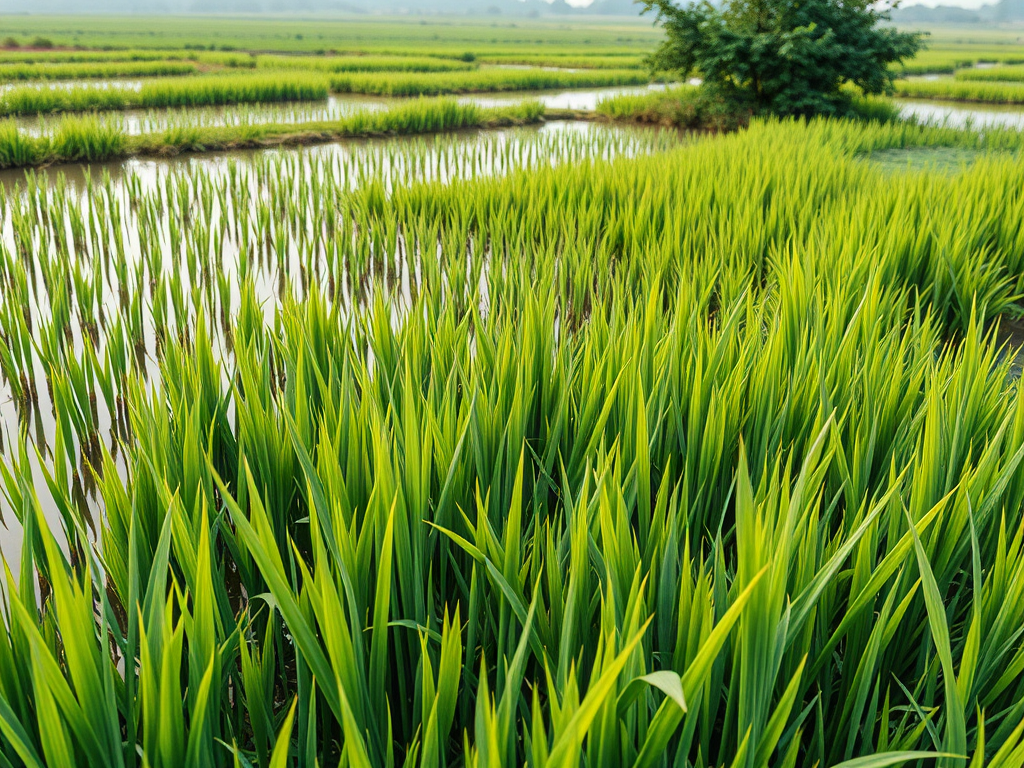
Wet rice farming requires level, bunded fields; soil that can retain water; a dependable irrigation and drainage system; suitable rice varieties; and water management matched to each growth stage. The goal is controlled saturation rather than permanently deep flooding: shallow water can suppress weeds and buffer moisture, while excessive depth wastes water, weakens young plants, and increases nutrient loss. Fields should be leveled, leaks repaired, and separate inlets and outlets installed before planting. Monitor soil moisture instead of irrigating by habit, avoid severe drying around flowering, and drain gradually as grain matures so the field is accessible at harvest.
What Does a Wet Rice Field Require?
A workable wet rice site combines water control, suitable soil, level ground, and a growing season long enough for the selected variety. Reliable control matters more than simply having a wet location. A marshy hollow that cannot be drained may be less suitable than a gently sloping plot supplied by a modest but controllable water source.
Rice tolerates saturated soil because its internal air spaces move oxygen toward submerged roots, but it is not an aquatic plant that benefits from uncontrolled flooding. Seedlings can be submerged, nutrients can move out of the root zone, and prolonged deep water may reduce tillering. The field therefore needs an inlet, an outlet, sound perimeter bunds, and enough elevation difference or pumping capacity to add and remove water intentionally.
Clay loam and other fine-textured soils usually retain ponded water better than coarse sand. Sandy ground is not automatically unusable, but seepage can make conventional flooded production impractical unless the subsoil restricts drainage or the plot is amended and compacted. Before building a paddy, fill a small test basin and watch how quickly the water disappears after accounting for evaporation. Rapid, uneven loss often points to porous soil, animal burrows, cracked bunds, or a hidden downslope leak.
The water source must also be evaluated through the entire crop cycle. A pond that is full during spring preparation may be unreliable when summer demand peaks. Check seasonal availability, pumping height, conveyance losses, sediment load, and water quality. Salty water or runoff carrying herbicide residues can injure rice and surrounding crops. Local water-withdrawal and wetland rules may apply even on private land, so confirm requirements before diverting a stream or reshaping a naturally wet area.
For a small homestead plot, prioritize these requirements in order:
- Controllable supply and drainage: Water must enter and leave without washing soil through the field.
- Accurate leveling: Small elevation differences create dry crowns and overly deep pockets.
- Low-seepage soil and secure bunds: Repairing leaks later consumes water and labor.
- Locally adapted seed: Match maturity period, temperature needs, and production method to the site.
A common mistake is selecting the lowest, wettest ground without checking drainage. Such a plot may appear ideal until heavy rain submerges seedlings or prevents harvest equipment from entering. Choose a field where excess water can be released safely, not merely one where water collects.
How Should a Paddy Field Be Prepared?
Field preparation should create a nearly level basin with stable bunds and controllable water structures. Start by surveying elevation rather than judging the surface by eye. A laser level is convenient, but a builder’s level, water level, or carefully marked stakes can identify high and low areas on a small plot. Divide steep land into separate terraces instead of trying to hold one deep sheet of water across the slope.
Bunds need a broad, compacted base rather than a loose ridge of topsoil. Build them with moist soil in layers, compact each layer, and remove roots or woody debris that can decay into leakage channels. Provide enough freeboard for rainfall without making the walls unnecessarily tall. Inspect for crayfish, rodents, settling, and erosion throughout the season. A narrow spillway or protected emergency outlet can direct storm overflow away from the weakest bank.
Inlet and outlet placement affects water distribution. Putting them at opposite sides encourages water to move across the basin, while placing them together may leave distant corners stagnant or dry. Screen incoming water where weed seeds, fish, or debris are concerns. Protect the outlet with stone, vegetation, pipe, or another erosion-resistant surface so draining does not cut through the bund.
Puddling—tilling wet soil into a soft layer—can reduce seepage and create conditions suited to transplanting. It may be useful where fine soil is available and water conservation is important. Repeated aggressive puddling has costs, however: it can damage soil structure below the worked layer and make rotation with upland crops more difficult. Direct-seeded rice may use less intensive preparation, but it demands better weed control and uniform moisture during establishment. The production method should determine the tillage plan, not the assumption that every rice field needs maximum mud.
Run a water test before planting. Add a shallow layer, mark the wet perimeter, and look for exposed rises, unexpectedly deep depressions, and fast leaks. Correcting a five-centimeter low pocket before transplanting is easier than managing submerged plants there for months. Cycle the inlet and outlet as well; gates that appear sound when dry may leak or jam under pressure.
The frequent failure mode is building the basin and planting immediately. Fresh bunds settle, channels clog, and unrecognized low areas collect deep water. A short test period reveals these faults while machinery and repair soil are still available. Preparation is complete only when the plot fills evenly, holds water at an acceptable rate, and drains without leaving isolated pools.
How Much Water Does Rice Need?
Rice water depth should change with establishment, weather, soil, and crop stage rather than remain fixed all season. Exact schedules differ by variety and production system, but shallow management is generally more controllable than deep flooding. Transplanted seedlings are commonly established in saturated soil or a very shallow layer; deeper water can bend or submerge small plants before their roots anchor.
Once plants are established, a shallow ponded layer—often roughly 2 to 5 centimeters where local practice supports it—can restrain some weeds and keep the root zone wet. More water is not a substitute for weed control. Deep flooding uses storage capacity, raises pressure on bunds, and may conceal uneven growth. After heavy rain, release excess water rather than preserving an arbitrary depth.
| Crop stage | Water-management priority | Warning sign |
|---|---|---|
| Germination or transplant recovery | Keep soil wet without deeply covering young plants | Floating seed, lodged seedlings, or exposed dry patches |
| Vegetative growth and tillering | Use shallow water or controlled wetting and drying | Persistent deep pockets or expanding soil cracks |
| Panicle development through flowering | Avoid moisture stress and rapid drying | Rolled leaves, dry root zone, or interrupted water supply |
| Grain filling | Maintain adequate moisture while reducing unnecessary ponding | Premature drying or prolonged deep flooding |
| Before harvest | Drain according to soil, weather, and variety maturity | Soft ground, standing pools, or crop stress from draining too early |
Alternate wetting and drying can reduce irrigation use where the field is well leveled and the operator can measure subsurface water. A perforated observation tube inserted into the soil lets the grower see the water level below the surface. One widely used approach allows the level in the tube to fall to a qualified threshold before re-irrigating; local rice specialists may use about 15 centimeters below the soil surface as a reference in suitable fields. That figure is not universal. Soil type, rooting depth, salinity, weed pressure, and crop stage can require a more conservative threshold, especially near flowering.
Small paddies are often irrigated by calendar because it feels predictable. The weakness is that a three-day interval may be too frequent after rain and too slow during hot, windy weather. Check the field itself: water depth, moisture below the surface, leaf posture, cracks, and variation between high and low areas. Keep brief records of pumping duration and rainfall so repeated overwatering becomes visible.
Draining before harvest should firm the soil and allow grain to finish without maintaining needless standing water. Draining too early can expose the crop to moisture stress; draining too late can delay access and leave rut-prone ground. Base the decision on crop maturity, soil drying rate, expected rain, and the harvest method rather than a single fixed date.
Monitoring, Drainage, and Water Problems
Daily observation should focus on water movement, not merely the depth beside the inlet. Walk or view the entire perimeter and compare the highest and lowest parts of the field. A single gauge can report an acceptable depth while distant plants stand dry or submerged. Simple marked stakes in multiple zones expose this variation and show whether leveling or flow distribution needs correction.
Unexpected water loss should be diagnosed before increasing pump time. Shut off the inlet, mark the waterline, and inspect bund faces, pipes, gates, burrows, and downslope ground. A wet patch outside the basin often identifies the leak. If water falls uniformly without visible leakage, infiltration and evaporation may be responsible. Continually replacing lost water without finding the pathway raises energy use and may carry dissolved nutrients away.
Poor drainage creates a different set of problems. Blocked outlets and undersized spillways allow storms to overtop bunds, erode soil, and move seed or young plants. Standing water left too deep for too long can limit tiller development and complicate weed or nutrient management. Clear debris before forecast rain, but release water slowly enough to prevent erosion and avoid sending muddy runoff directly into waterways.
Water appearance can provide clues but should not be treated as a diagnosis. Cloudiness after tillage is expected, while persistent turbidity from an eroding inlet calls for flow control. Algal growth may reflect warm, still water and available nutrients, but adding chemicals without identifying the species or cause can damage the crop and downstream habitat. If salinity, contamination, or nutrient imbalance is suspected, laboratory testing through an agricultural service is more reliable than judging color or odor alone.
A practical inspection routine includes checking inlet flow, outlet function, bund integrity, representative water depths, and plant uniformity. After rain or irrigation, note whether high areas wet promptly and low spots drain with the rest of the field. Healthy progress appears as even establishment, stable bunds, manageable weed pressure, and predictable filling and drainage. Repeatedly dry ridges, yellow or stunted patches aligned with deep zones, fresh cracks, and rising pumping time indicate that the system—not just the crop—needs correction.
The costly misconception is that flooding automatically protects rice from drought. A field can hold visible water yet receive uneven distribution, and a failing source can leave the crop vulnerable at a sensitive stage. Maintain a reserve plan where possible: stored water, a backup pump, or a reduced planted area matched to dependable supply. Planting fewer square meters with reliable control is usually more defensible than expanding a basin that cannot be watered or drained when conditions change.
Frequently Asked Questions
Does rice need to remain flooded throughout the season?
No. Rice needs dependable moisture, but many fields can be managed with shallow ponding or controlled wetting and drying. Avoid severe drying during sensitive reproductive stages.
What soil is best for a small rice paddy?
Fine-textured clay loam commonly holds water well. Sandy soil may lose water rapidly unless a restrictive subsoil or carefully prepared compacted layer limits seepage.
How deep should water be in a rice field?
Depth varies by stage and system. Established transplanted rice is often managed with roughly 2 to 5 centimeters of ponded water, while young seedlings generally require shallower conditions.
Can rice be grown without a natural wetland?
Yes. A level, constructed basin with a reliable supply, stable bunds, and controlled drainage can support wet rice. Avoid converting protected wetlands without confirming applicable rules.
Why is one part of a paddy dry while another is flooded?
Uneven grading is the usual cause, although blocked channels or poor inlet placement may contribute. Measure elevations and water depths at several points before adding more water.
Conclusion
Successful paddy management comes from controlling water precisely enough to respond to the crop, soil, and weather. Begin by confirming that the site can hold water without becoming impossible to drain. Level the basin, compact and test the bunds, and make the inlet and outlet functional before seed or transplants enter the field.
During growth, use field observations rather than a rigid irrigation calendar. Compare depths across the plot, investigate sudden losses, release storm water safely, and protect the crop from serious moisture stress as it approaches flowering. Before harvest, reduce water according to maturity, forecast conditions, and the time the soil needs to support workers or equipment. A small test basin and one season of accurate water records can reveal whether the site is suitable for expansion without committing the homestead to an oversized, water-hungry system.