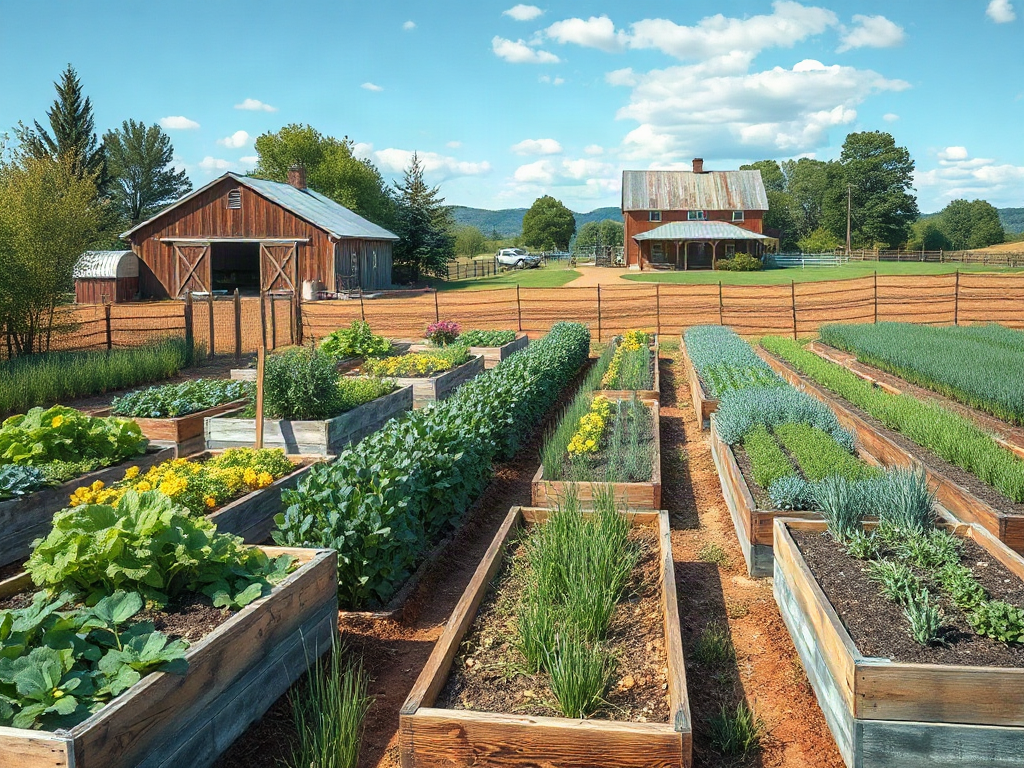
Gardening versus farming for a beginner homestead is best treated as a staged decision: establish a manageable food garden first, then add farm-scale production only after measuring labor, land, water, and harvest demand. Gardening emphasizes household crops in intensively managed beds, while farming adds larger acreage, repeated field work, market output, livestock, or substantial equipment. A first-year plan should favor reliable vegetables, simple irrigation, soil improvement, and accurate harvest records. Expanding too early can turn unused produce, weed pressure, equipment costs, and seasonal workload into bigger problems than limited growing space.
What you’ll learn
This guide covers the following practical points:
- How Gardening and Farming Differ on a Homestead — A garden and a farm differ more in operating scale and purpose than in the crops they contain.
- How to Choose the Right Starting Scale — The right starting scale is the area a household can prepare, water, weed, harvest, and process during its busiest weeks.
- A Practical Year-One Growing Plan — A sound first season should test the homestead's soil, water, labor, and food-use capacity without committing the whole property.
- Signs the Homestead Is Ready to Expand — Expansion is justified when existing beds are consistently maintained and the extra production has a defined destination.
How Gardening and Farming Differ on a Homestead
A garden and a farm differ more in operating scale and purpose than in the crops they contain. A homestead garden usually supplies fresh food for one household through closely spaced beds, hand tools, frequent attention, and varied plantings. Farming applies similar growing principles across a larger or more specialized operation, often with planned production targets, mechanized tasks, livestock, or products intended for sale.
The distinction becomes clear when ordinary chores are multiplied. Pulling weeds from six vegetable beds may take an hour, while controlling weeds across several long crop rows may require a wheel hoe, cultivator, mulch-laying system, or repeated tractor passes. Watering a compact garden can be handled by drip lines connected to a household supply. A field may need greater flow, longer distribution lines, filtration, storage, or a dedicated water source.
Production goals matter as much as acreage. A quarter-acre planted intensively for a market stand can function like a small farm, while a larger property with a few beds remains a garden. Selling vegetables also adds washing, sorting, packaging, storage, customer communication, and dependable harvest timing. Those obligations continue even when weather, pests, or personal schedules interfere.
A common mistake is assuming that more land automatically produces more useful food. Additional rows also create more transplanting, irrigation, pest monitoring, harvesting, and preservation work. A smaller plot that receives timely care commonly contributes more to the household than an oversized planting lost to weeds or left unharvested.
How to Choose the Right Starting Scale
The right starting scale is the area a household can prepare, water, weed, harvest, and process during its busiest weeks. Available acreage is only an upper limit; labor and water usually determine how much ground can be managed well. Before breaking soil, observe sun exposure, drainage, frost pockets, access from the house, and the distance between the plot and its water source.
Begin with crops the household already eats and can use at harvest. Salad greens, beans, summer squash, tomatoes, roots, and culinary herbs offer different planting and storage patterns, but not every crop suits every climate or schedule. Someone away from home during summer may prefer storage onions, winter squash, dry beans, or potatoes over crops that require near-daily picking.
| Decision Factor | Garden-Scale Start | Farm-Scale Start |
|---|---|---|
| Primary goal | Fresh food and household preservation | Regular sales, feed production, or larger supply targets |
| Labor | Hand work fitted around other responsibilities | Scheduled field, harvest, and handling work |
| Tools | Hand tools, hoses, and small tillage equipment | Specialized implements or mechanized systems |
| Crop selection | Several foods in modest quantities | Fewer crops grown in larger, repeatable plantings |
| Harvest destination | Kitchen, pantry, freezer, or neighbors | Customers, storage, livestock, or wholesale channels |
Budget decisions should follow demonstrated needs. Renting a tiller once, hiring initial bed preparation, or using a broadfork may be more sensible than buying machinery before the plot size is settled. Likewise, fencing can deserve priority over additional beds where deer, rabbits, or roaming poultry threaten young crops.
Measure success by completed cycles rather than planted area. A successful bed is prepared on time, planted, maintained, harvested, and cleared or replanted. When several beds repeatedly fail at the weeding or harvesting stage, expanding the footprint will magnify the bottleneck instead of solving it.
A Practical Year-One Growing Plan
A sound first season should test the homestead’s soil, water, labor, and food-use capacity without committing the whole property. Select one accessible growing area, define permanent beds and paths, and protect the site before ordering a large seed collection. Permanent paths prevent productive soil from being compacted and make irrigation and weed control easier to organize.
Use the following sequence as a compact year-one checklist:
- Map the site: Record direct sunlight, slope, drainage, water access, and likely animal pressure.
- Assess the soil: Obtain a soil test through an appropriate local laboratory and use the results rather than guessing at amendments.
- Limit the crop list: Choose foods the household will eat, preserve, or share, including a few dependable crops and one or two experiments.
- Install watering early: Set up hoses, drip lines, or another workable system before dry weather makes daily hand watering burdensome.
- Plan harvest use: Match planting quantities to refrigerator, freezer, pantry, and preservation capacity.
- Keep records: Note sowing dates, harvest amounts, pest problems, time spent, and crops that went unused.
Staggering some plantings reduces the risk of receiving an unmanageable harvest at once. Instead of sowing every bush bean on one day, for example, a homesteader can make smaller plantings at suitable intervals during the local season. Succession planting still requires realistic timing; later crops may face heat, cold, shorter daylight, or different pest pressure.
Soil improvement should be deliberate rather than amendment-heavy. Compost, mulch, cover crops, and targeted fertilizers serve different purposes, and adding them without knowing soil conditions can waste money or create nutrient imbalances. Organic matter does not compensate for poor drainage, inadequate sunlight, or an unreliable water supply.
The first season is also a test of household workflow. Track whether produce is picked before it becomes overripe, whether preserving competes with work or childcare, and whether paths remain passable during wet periods. These observations reveal more about sustainable scale than an ambitious planting map drawn during winter.
Signs the Homestead Is Ready to Expand
Expansion is justified when existing beds are consistently maintained and the extra production has a defined destination. Useful signs include timely weed control, dependable irrigation, good harvest use, workable storage, and records showing that household demand exceeds current output. Expansion may mean adding two beds, extending the growing season, increasing a successful storage crop, or testing a small sales channel—not immediately converting an entire field.
Add capacity at the point where a constraint has been solved. If watering consumes too much time, improve irrigation before increasing acreage. If produce is being wasted, develop preservation routines or reduce plantings before adding crops. If tools are causing delays, calculate whether a specific implement would remove the bottleneck often enough to justify its purchase and maintenance.
Moving toward farming also requires attention beyond cultivation. Products intended for sale need consistent quality, realistic pricing, harvest handling, suitable storage, and compliance with applicable local rules. Requirements vary by location and by product, especially when eggs, dairy, meat, processed foods, or public access are involved. Check with relevant local agriculture, planning, health, and tax authorities before building a business plan around sales.
Failure signals should prompt correction rather than expansion. Persistent weeds going to seed, empty beds during the growing season, stressed crops from missed watering, unused harvests, and unfinished preservation projects indicate that the current system is already too large or poorly arranged. Shrinking the plot, simplifying the crop list, or changing bed placement can be a productive management decision.
Frequently Asked Questions
How much land does a beginner homestead garden need?
No fixed acreage suits every household. Start with an area that can be watered, weeded, harvested, and cleared reliably, then expand after a complete season of records reveals actual capacity.
When does a large garden become a farm?
There is no universal acreage threshold. Regular sales, specialized production, mechanized field work, livestock, or formal production targets often make an operation function more like a farm than a household garden.
Should a beginner buy a tractor before planting?
Usually not unless the property already has clearly defined tractor-scale work. Renting equipment or hiring initial preparation avoids committing money to a machine before the homestead's recurring needs are known.
Which crops are practical for a first-year homestead?
Choose foods the household regularly uses and crops suited to the local season. Include a manageable mix of frequently harvested vegetables and storage crops rather than growing large amounts of unfamiliar produce.
Can a homestead sell surplus garden produce?
Possibly, but sales rules vary by location and product. Confirm applicable business, zoning, food-handling, tax, and market requirements with local authorities before relying on surplus sales.
Conclusion
A beginner homestead benefits from proving its growing system before enlarging it. Build accessible beds, secure water and crop protection, plant foods with a planned use, and record where labor or storage falls short. Expand only after the existing plot remains productive through busy weeks and additional harvests have a clear destination. That measured progression preserves the option to develop a small farm without making farm-scale costs and workload the first experiment.