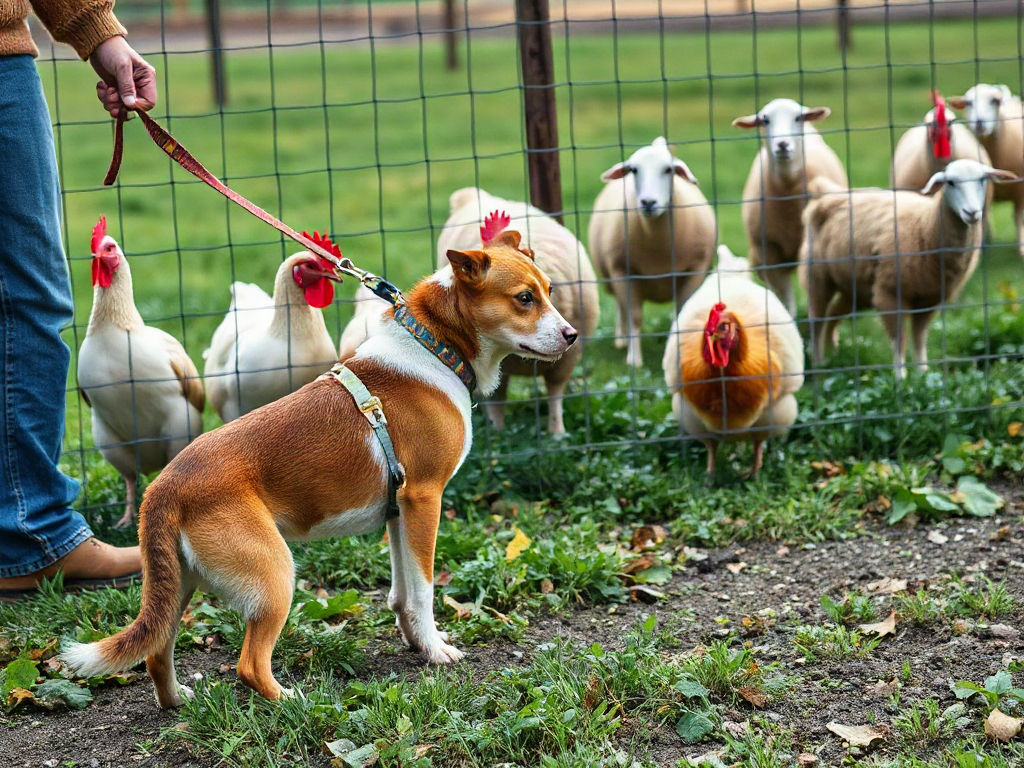
Farm dog safety around poultry and livestock depends on controlled access, secure barriers, supervised exposure, and prompt interruption of stalking or chasing. A dog’s calm behavior at the fence does not prove it can be trusted inside a coop, lambing pen, or pasture, especially when birds flap or young animals run. Use a leash or long line during training, reward disengagement from animals, and separate the dog whenever direct supervision is unavailable. Watch for hard staring, crouching, trembling, lunging, fence running, or ignored cues; these signs mean distance and management should increase rather than testing the dog off leash.
What you’ll learn
This guide covers the following practical points:
- Separate Management From Trust — Physical separation protects animals while a dog’s behavior is still being assessed.
- Introduce Dogs Without Triggering Chases — Initial exposure should happen at enough distance for the dog to notice the animals without fixating on them.
- Read Behavior Before an Incident — Early warning signs often appear before barking, lunging, or pursuit.
- Build a Daily Safety Plan — A practical routine assigns the dog a safe location during every livestock task.
Separate Management From Trust
Physical separation protects animals while a dog’s behavior is still being assessed. Use a secure coop, pasture fence, kennel, gate system, or closed building to prevent access when nobody is actively watching. The barrier must match the dog: a low fence may stop a calm older dog but invite an athletic dog to jump, climb, dig, or push underneath it.
Familiarity should not be mistaken for reliability. A dog may ignore resting hens for weeks and then chase when a bird squawks and flies. Likewise, cattle that stand quietly can trigger different behavior when they run, crowd a gate, or protect a calf. Predatory interest, herding behavior, fear, territorial reactions, and play can all injure stock even when the dog shows no obvious aggression.
Build redundancy into high-risk areas. A latched coop inside a fenced poultry yard offers more protection than either barrier alone. Around birthing pens, brooder areas, sick animals, and newly arrived stock, use complete separation rather than relying on verbal control. The common failure is granting freedom because previous encounters went well; safe management assumes conditions can change.
Introduce Dogs Without Triggering Chases
Initial exposure should happen at enough distance for the dog to notice the animals without fixating on them. Begin outside a secure enclosure with the dog on a well-fitted leash. Reward brief observation followed by looking back at the handler, moving away, or settling. If the dog strains forward, freezes, whines intensely, or cannot take food, increase the distance rather than repeating commands at close range.
Progress by behavior, not by a preset calendar. A useful sequence is:
- Observe through a secure barrier: Reinforce loose posture and voluntary disengagement.
- Walk parallel to the enclosure: Keep enough space to avoid fence charging or flock movement.
- Practice near routine activity: Work during feeding, gate opening, or animal movement while maintaining control.
- Use a long line only in a safely enclosed area: Prevent chasing without giving the dog uncontrolled freedom.
- Consider closer access cautiously: Do so only after calm behavior is consistent under varied conditions.
For example, a dog that remains relaxed beside penned hens may become highly aroused when birds are released. That is not a minor setback; it shows that motion is a trigger requiring more distance and controlled repetition. Do not tether a dog where livestock can approach, corner, kick, or butt it. Confinement removes the dog’s ability to retreat and may increase defensive behavior.
Read Behavior Before an Incident
Early warning signs often appear before barking, lunging, or pursuit. Hard staring, a closed mouth, lowered head, slow stalking, trembling, weight shifted forward, and repeated attempts to circle an enclosure can indicate escalating interest. With larger livestock, watch for avoidance, frantic barking, snapping near heels, or attempts to control movement by rushing animals.
Calm behavior looks different from suppressed behavior. A relaxed dog can turn away, sniff, respond to a familiar cue, and move with a loose body. A motionless dog that cannot disengage may be intensely focused rather than settled. Test responsiveness by increasing distance and asking for an easy, well-practiced behavior. Failure to respond near animals usually means the setting is too difficult, not that the cue needs to be repeated more loudly.
| Observed behavior | Likely safety meaning | Immediate response |
|---|---|---|
| Loose body and easy disengagement | Arousal is manageable | Continue briefly and reward calm choices |
| Fixed stare or crouching | Possible stalking or intense fixation | Increase distance and end close exposure |
| Fence running or lunging | Control has already deteriorated | Remove the dog and strengthen separation |
| Livestock bunching, fleeing, or striking | The animals feel pressured or threatened | Stop the interaction immediately |
The animals’ behavior matters as much as the dog’s. Repeated disturbance can reduce feeding, separate young animals from their mothers, cause birds to pile into corners, or provoke defensive kicks and charges. Waiting for physical contact sets the threshold far too late.
Build a Daily Safety Plan
A practical routine assigns the dog a safe location during every livestock task. Before opening a coop, moving a herd, collecting eggs, or driving equipment through a gate, confirm whether the dog is secured, leashed, or under direct control. Household members and visitors should follow the same rules; an unlatched gate can undo months of careful management.
Use a short pre-release check:
- Confirm coop doors, pasture gates, and kennel latches are closed.
- Check fences for digging, storm damage, loose wire, and gaps beneath gates.
- Locate vulnerable animals, including chicks, newborns, injured stock, and animals giving birth.
- Carry a leash rather than depending entirely on recall.
- End access if either the dog or the stock becomes agitated.
Match privileges to the day’s conditions. A dog that behaves appropriately around mature sheep may still need separation during lambing. Poultry released into a new area may flap and scatter more than usual. Delivery vehicles, wildlife, storms, or unfamiliar animals can raise arousal. The weak assumption is that training permanently overrides instinct; daily management accounts for changing triggers.
Signs the plan is working include uneventful chores, loose canine body language, animals continuing normal feeding and movement, and immediate response to redirection. Repeated fence testing, escalating vocalization, missing feathers, unexplained wounds, or frightened stock indicate that access should be reduced and barriers reviewed.
Respond to Chasing or Injury
A chase should immediately end the dog’s access to the animals. Secure the dog without striking, cornering, or creating another chaotic pursuit. Account for every animal, move injured stock to a quiet protected area, and contact a veterinarian promptly when there are punctures, crushing injuries, breathing difficulty, heavy bleeding, inability to stand, or other serious concerns. Fur or feathers can conceal wounds.
Afterward, identify how access occurred and what triggered the event. Repair the failed gate or fence before resuming normal routines. Training should restart at a distance where the dog can remain responsive, but management must carry the safety burden; recall practice alone is not a reliable substitute for containment.
Repeated pursuit, intense fixation, or behavior that the handler cannot safely interrupt calls for qualified help. A veterinarian can evaluate pain, anxiety, or sudden behavioral change, while a credentialed behavior professional experienced with dogs around farm animals can help assess risk. Some dogs may never be appropriate for loose access to poultry or certain livestock. Permanent separation can be the responsible outcome, not a training failure.
Frequently Asked Questions
Can any dog learn to be safe around chickens?
Not every dog is a suitable candidate for unrestricted poultry access. Training may improve control, but strong predatory behavior, persistent fixation, or a history of attacks may require permanent physical separation.
When can a farm dog be left alone with livestock?
Unsupervised access should never be assumed safe merely because supervised sessions went well. Consider the dog’s role, behavior history, stock species, fencing, and changing conditions; many dogs should remain separated whenever nobody is present.
Should poultry correct an overcurious puppy?
No. Allowing a rooster, goose, or larger animal to frighten or strike a puppy risks injury and can create defensive aggression. Use a leash, distance, and barriers instead.
Is recall enough to stop livestock chasing?
Recall is useful but may fail when movement triggers intense arousal. Secure fencing, leashes, long lines, and controlled access provide protection even when the dog does not respond immediately.
What should I do if my dog suddenly starts chasing stock?
Separate the dog, inspect the animals, and check for changes such as pain, new stock, wildlife activity, altered fencing, or a recent frightening event. Seek veterinary or qualified behavioral help when the change is abrupt or persistent.
Conclusion
Reliable safety comes from controlling opportunity, reading arousal early, and protecting animals before testing a dog’s limits. Secure vulnerable stock first, introduce the dog at a workable distance, and make calm disengagement the standard for progress. Review gates and fences during daily chores, tighten management when animals are young, injured, or giving birth, and treat any chase as evidence that the current setup failed. When risk remains high, professional assessment and permanent separation are safer than repeated off-leash trials.