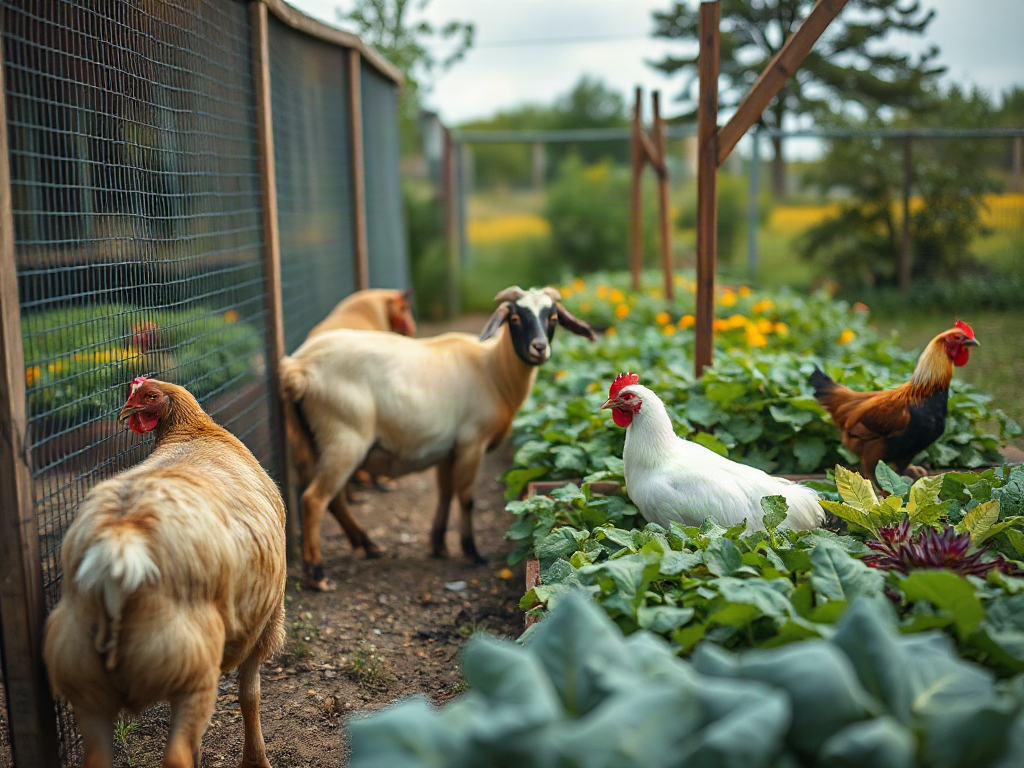
Farm fencing options for goats, poultry, and gardens work best when each barrier matches the animal or threat rather than forcing one material to do every job. Goats generally need rigid woven wire or well-maintained electric fencing, while poultry requires smaller openings near ground level and stronger nighttime predator protection. Gardens benefit from fencing chosen for the local pressure, such as deer height, rabbit-size mesh, or an electric offset for persistent browsers. Strong posts, tight gates, protected corners, and routine voltage or damage checks often matter as much as the fence material itself. A layered layout usually delivers better control and easier repairs than a single universal perimeter.
What you’ll learn
This guide covers the following practical points:
- Match the Fence to the Animal or Threat — A useful fence plan begins by identifying what must stay in, what must stay out, and whether the barrier is permanent or movable.
- Fencing That Holds Goats Reliably — Goat fencing must resist climbing, rubbing, reaching, and pressure at gates.
- Poultry Fencing and Predator Protection — Poultry containment and predator exclusion are separate jobs.
- Garden Fencing for Deer, Rabbits, and Livestock — Garden fencing should be selected around the most damaging visitor, not merely the smallest one.
Match the Fence to the Animal or Threat
A useful fence plan begins by identifying what must stay in, what must stay out, and whether the barrier is permanent or movable. A fence that contains calm laying hens during the day may offer little resistance to a digging predator at night. Likewise, wire that excludes rabbits can still allow a goat to lean over and damage vegetables.
Opening size, fence height, ground contact, visibility, and physical strength solve different problems. Woven wire provides a substantial physical barrier. Electric wire or netting relies on a memorable shock and therefore needs reliable grounding, adequate voltage, and vegetation control. Welded wire is convenient around gardens and runs, but repeated pushing or climbing may distort welds. Hardware cloth has much smaller openings and is better suited to vulnerable coop vents, brooder areas, and lower run walls than to long pasture boundaries.
| Use | Practical Starting Option | Main Limitation |
|---|---|---|
| Permanent goat paddock | Strong woven wire with secure bracing | Higher installation effort and cost |
| Rotational goat area | Electrified netting or multiple electric strands | Requires training, power, and vegetation control |
| Daytime poultry range | Poultry netting or lightweight mesh | Not automatically secure against every predator |
| Night poultry enclosure | Rigid mesh with protected openings and edges | More material and construction time |
| Vegetable garden | Welded or woven mesh sized to local pests | Height and lower openings must match the threat |
A mixed homestead often works better with zones: a durable outer livestock boundary, movable interior divisions, a reinforced poultry enclosure, and a separate garden fence. The common mistake is buying one inexpensive mesh for every zone, then discovering that its openings, strength, or height fail in several different ways.
Fencing That Holds Goats Reliably
Goat fencing must resist climbing, rubbing, reaching, and pressure at gates. Strong woven field fence is a common permanent choice because it forms a visible physical barrier and distributes pressure across multiple wires. Mesh openings should not invite a goat to push its head through, especially where horned goats are kept. If an animal can reach desirable browse through the fence, repeated leaning can loosen wire and posts.
Electric fencing can divide pasture efficiently when goats have been introduced to it in a controlled area and the energizer, grounding system, and conductors are functioning correctly. Multiple smooth strands allow flexible spacing, while electrified netting creates a more visible temporary boundary. Netting is heavier to move and can sag on uneven ground; loose sections may create an entanglement concern. Power should be disconnected before moving or repairing it.
Barbed wire is generally a poor primary choice for small goat enclosures because goats may push, climb, or become caught rather than respecting it as a visual boundary. Cattle panels are rigid and useful for compact pens, handling areas, or reinforcing a weak gate, but their cost and fixed lengths make them less practical for extensive paddocks.
For a practical combination, consider woven wire around the property and an electric offset inside sections where goats challenge the boundary. The offset discourages rubbing before animals place their full weight on the mesh. This arrangement still depends on sound corner braces and a clear electric line; adding a hot wire to a leaning, poorly tensioned fence does not repair the underlying structure.
Poultry Fencing and Predator Protection
Poultry containment and predator exclusion are separate jobs. Standard poultry wire can keep many chickens in a designated space, but its thin construction and larger openings should not be assumed to create a secure nighttime enclosure. A coop and enclosed run need attention at doors, vents, roof edges, corners, and the ground line because those are common access points.
Rigid, small-opening hardware cloth is well suited to coop windows, ventilation openings, and vulnerable portions of a run. Fasteners should grip framing securely; light staples alone may loosen under repeated force. At the bottom edge, builders often extend mesh outward as a ground apron or install another protected edge detail to discourage digging. Local soil, drainage, frost movement, and predator behavior influence which method is practical.
Electrified poultry netting is useful for rotating birds through an orchard or pasture. It is quick to reposition compared with permanent mesh, but it requires a clear fence line and frequent inspection for sagging, shorts, or birds slipping beneath uneven sections. It may reduce pressure from some ground predators when operating correctly, yet it should not replace a secure coop for overnight confinement.
Overhead exposure also deserves attention. A roofed run offers stronger physical protection than an open pen, while overhead lines or netting may deter some aerial approaches without creating a fully enclosed barrier. The weak assumption is that a tall side fence protects every direction. Evaluate the entire enclosure, including places where branches, structures, or stored equipment provide climbing or jumping access.
Garden Fencing for Deer, Rabbits, and Livestock
Garden fencing should be selected around the most damaging visitor, not merely the smallest one. Deer pressure calls for a tall, highly visible barrier or a carefully designed electric system. Rabbits require small openings near soil level, while poultry can pass through surprising gaps and scratch beneath loosely fitted mesh. Goats demand enough setback that they cannot reach crops through the fence.
Welded wire on sturdy posts is practical for many household gardens because it is easy to see, supports gates cleanly, and can be paired with smaller mesh along the bottom. Plastic deer mesh costs less and is lighter to handle, but it is less resistant to chewing, falling branches, equipment contact, and long-term weathering. Woven wire is stronger for gardens bordering livestock lanes, although installation requires better bracing and tensioning.
Consider an illustrative mixed-pressure garden beside a goat paddock with rabbits entering from a hedgerow. A sensible design would use a rigid perimeter, small-opening mesh at the base, and either added height or a deer deterrent appropriate to the site. On the goat side, leaving a clear buffer or adding an interior electric offset keeps animals from pruning plants through the mesh. The layers address four different actions: jumping, squeezing, digging, and reaching.
Gate design often determines whether the plan succeeds. A generous gate makes wheelbarrow and tiller access easier, but the bottom gap must remain small enough for the target pest. Remove soil buildup that prevents latching, and avoid placing compost, lumber, or trellises where they become steps beside the fence.
Posts, Gates, and Maintenance That Prevent Failures
Fence reliability depends on structure and inspection more than the label on the wire roll. Corners and ends carry tension, so they need stronger posts and bracing than intermediate line posts. Gates add leverage and repeated movement; a gatepost that shifts slightly can create a gap, drag on the ground, or stop the latch from aligning.
Walk each boundary after storms, mowing, pasture moves, or signs of animal pressure. Look for stretched mesh, loose ties, lifted bottom edges, broken insulators, vegetation touching electric conductors, and soil erosion under gates. For electric systems, use a suitable fence tester rather than judging performance by sound or appearance. A visibly intact line may still be ineffective because of poor grounding, depleted power, damaged connections, or heavy plant contact.
A compact inspection order keeps repairs focused:
- Check gates, latches, corners, and changes in terrain.
- Follow the bottom edge for digging, washouts, or lifted mesh.
- Inspect the upper edge for leaning, reaching, and fallen limbs.
- Test electric sections and clear growth causing shorts.
- Watch animal behavior for repeated pacing, pushing, or testing.
Animals repeatedly gathering at one point usually reveal an attraction or weakness: fresh browse outside a goat fence, feed near a poultry boundary, or a familiar route into the garden. Repair the structure, then remove the incentive where possible. Continually patching the same spot without changing feed placement, vegetation, or traffic flow leaves the cause in place.
Frequently Asked Questions
What type of fence is most reliable for goats?
Well-braced woven wire is a dependable permanent barrier for many goat paddocks. An interior electric offset can discourage rubbing and reaching, provided the electric system is maintained and the goats are properly introduced to it.
Is chicken wire enough for a secure poultry run?
Chicken wire is mainly a poultry-containment material, not a complete predator barrier. Vulnerable runs generally need stronger small-opening mesh, secure framing, protected edges, dependable latches, and attention to overhead access.
Can electric netting be used for both goats and chickens?
Purpose-made electrified netting can support rotational areas for either animal, but mesh design, height, energizer capacity, and setup must suit the intended species. Inspect for sagging, grounding problems, vegetation contact, and possible entanglement.
How should a garden fence protect against rabbits and deer?
Combine small openings at ground level for rabbits with sufficient height or another site-appropriate deterrent for deer. Seal gate gaps and inspect for washouts, because a tall fence still fails if animals can pass underneath.
Where should fence money be spent first?
Prioritize sound corner assemblies, strong gateposts, reliable latches, and the correct mesh for the main threat. These high-load and high-traffic points usually deserve better materials before money is spent upgrading low-pressure interior divisions.
Conclusion
Build the permanent boundaries around the strongest pressure, then use movable or specialized fencing inside them. Goats need resistance to leaning and reaching, poultry need separate daytime containment and nighttime security, and gardens need barriers matched to local animals. Before buying materials, map gates, corners, slopes, power access, and likely digging points. Inspect those locations routinely, and treat repeated animal pressure as evidence that either the structure or the surrounding layout needs correction.