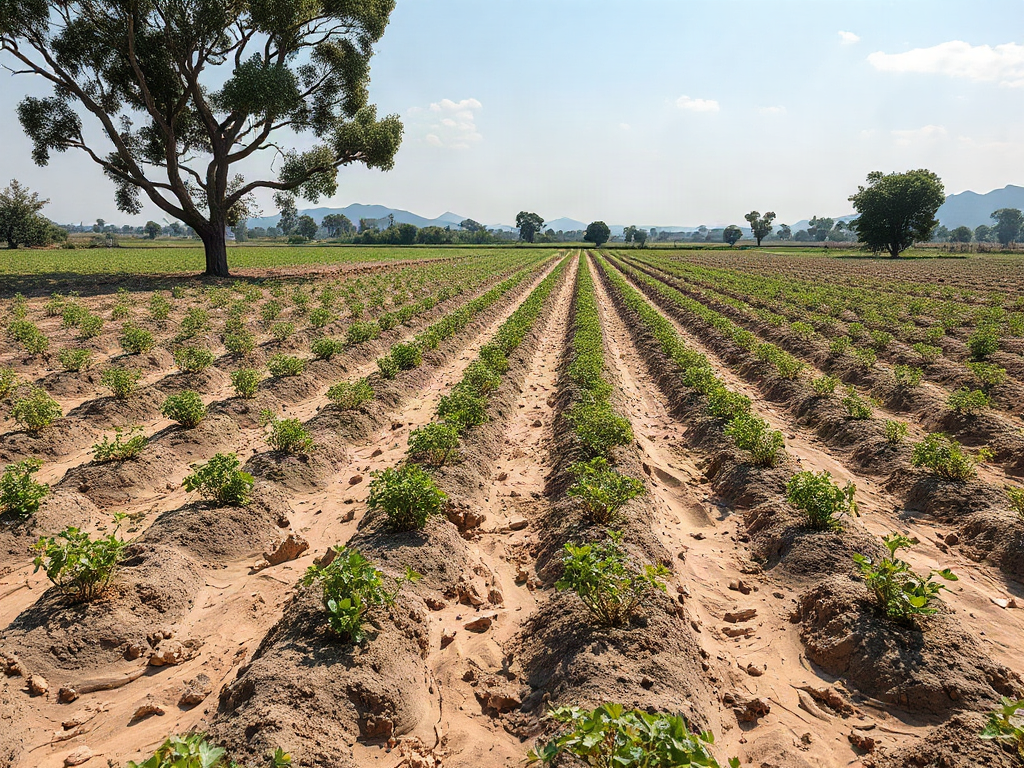
Strip farming is an erosion-control method that divides a field into alternating bands of row crops, close-growing crops, or protective cover arranged across a slope or along its contour. For erosion-conscious growers, the strips interrupt runoff, slow moving water, trap displaced sediment, and reduce the length of exposed soil. Effective layouts account for slope, soil erodibility, field shape, equipment width, and the protective value of each crop. Narrower bands may be needed on steeper or highly erodible ground, while poorly aligned strips can concentrate water and undermine the intended protection.
How Does Strip Farming Control Erosion?
Water erosion becomes more damaging when runoff can travel uninterrupted over bare or finely worked soil. A long cultivated slope gives water room to accelerate, detach particles, and carry them downhill. Alternating that exposed ground with dense vegetation or heavy residue shortens the effective slope length and places rough, permeable surfaces in the runoff path.
The protective bands perform several related jobs. Standing plants and residue absorb some of a raindrop’s impact before it reaches the soil. Roots hold aggregates together and maintain pores through which water can enter. At ground level, stems and residue create resistance that slows shallow flow. As runoff loses speed, it carries less sediment, so some displaced soil settles within the protected band instead of leaving the field.
Consider a hillside planted entirely to a wide-row crop with little early-season canopy. During intense rain, water may run between rows for a substantial distance. If that hillside is divided into alternating bands of the row crop and a dense small grain or perennial forage, runoff repeatedly encounters a rougher surface. The field remains productive, but the erosion pathway is broken into shorter segments.
Strip farming differs from simply rotating crops over time. Rotation changes what occupies the whole field from season to season, while strip farming places contrasting covers beside one another during the same erosion-risk period. The two practices can work together: strips can exchange crop roles in later years so that soil-building crops occupy ground previously used for more erosion-prone production.
The arrangement should not be treated as a sediment trap that excuses aggressive tillage. Soil collected at the lower edge of a strip has still moved from its original position, potentially taking organic matter and nutrients with it. A successful system minimizes movement at the source through residue cover, reduced disturbance, healthy crop establishment, and strips positioned to intercept rather than channel flow. After heavy rain, look for muddy deposits, small rills, exposed roots, or water marks. Repeated evidence in the same place indicates that strip spacing, orientation, surface cover, or drainage needs adjustment.
Which Strip Farming Layout Fits the Field?
The best layout follows the dominant erosion process rather than forcing one pattern onto every field. Contour strip cropping is the most recognizable form: crop bands follow mapped contour lines, staying as close as practical to a constant elevation. This arrangement resists downhill flow and is generally more relevant on rolling land where water erosion is the primary concern.
Field strip cropping uses bands that are more uniform and convenient for machinery, even when they do not precisely follow every contour. It can simplify planting, spraying, and harvesting on gently sloping or irregular parcels. That convenience has a cost. If straight strips angle downhill, wheel tracks and crop rows may become flow paths. A grower choosing field strips should verify where water actually travels rather than assuming that a visually tidy layout is protective.
Wind strip cropping addresses a different force. Bands are placed across the direction of prevailing erosive winds, often combining a vulnerable crop with a denser or more persistent cover. The rougher strips reduce wind speed near the ground and interrupt the distance over which loose particles can move. A contour layout aimed at runoff may not have the correct orientation for wind protection, so fields exposed to both hazards may require a compromise or additional windbreak measures.
Buffer strips are related but not identical. A grassed band beside a waterway, ditch, or field edge primarily filters runoff and stabilizes a sensitive area; it may remain in permanent vegetation rather than rotating among crops. Strip farming usually refers to a repeated pattern within the cropped field. Permanent buffers are valuable companions, especially where concentrated flow leaves the alternating crop bands.
Map the field before settling on a layout. Mark slope changes, drainage swales, wet spots, eroded knolls, property boundaries, and safe equipment turning areas. Observe runoff during rain if conditions permit without entering flooded or unstable ground. A small homestead plot may tolerate curved contour rows worked with compact equipment, whereas a larger operation may need parallel passes that accommodate implements. The common failure is prioritizing perfectly equal bands while ignoring a swale that collects water. Water movement, not visual symmetry, should govern the final pattern.
Planning Strip Width and Placement
Strip dimensions should reflect erosion risk and workable equipment modules rather than a universal width. Steeper slopes, fragile surface soil, sparse crop cover, and long downhill runs generally call for more frequent protective bands. Gentler ground with stable aggregates and substantial residue may permit wider cultivated bands, but local soil and rainfall conditions still matter.
Start by identifying the least-protected stage of the crop cycle. A band that looks covered in midsummer may be nearly bare after seedbed preparation or harvest. Pair the vulnerable strip with vegetation that remains dense during that window, such as established forage, a close-growing grain, or a well-timed cover crop. If both neighboring strips are bare at the same time, the alternating pattern offers little interruption when erosion risk is highest.
Equipment can set useful boundaries without dictating the conservation plan. Strip widths commonly need to match whole passes of the planter, cultivator, mower, sprayer, or harvester. Partial passes create overlaps, missed rows, awkward turns, and excess traffic. On a small property, the same principle applies to a walk-behind tractor or hand-scale bed system: choose widths that can be planted and maintained without repeatedly crossing the protected strip.
A practical planning sequence is:
- Trace water and wind exposure. Mark the longest slopes, visible rills, depositional areas, and prevailing erosive wind direction.
- Choose the protective crop. Favor dense cover that is present during the vulnerable crop’s bare-soil period.
- Fit complete equipment passes. Adjust the preliminary bands to realistic working widths without creating downhill channels.
- Protect concentrated flow. Keep natural swales in stable vegetation or route water to a suitable stabilized outlet rather than tilling through them.
- Inspect and revise. Check the field after major runoff events and after operations that leave wheel tracks or residue gaps.
Signs of a sound layout include little visible soil movement, no expanding rills, residue remaining in place, and runoff spreading shallowly rather than collecting in narrow channels. Warning signs include sediment fans at strip boundaries, gullies crossing several bands, ponding that harms crops, or repeated wheel-track erosion. Moving a boundary, narrowing an exposed band, changing traffic direction, or establishing a permanent grassed channel may be more effective than merely adding another crop species.
Where Does Strip Farming Fall Short?
Strip farming reduces exposure to erosive forces, but it does not safely handle every volume or concentration of water. Once runoff gathers in a defined channel, alternating crop bands may be crossed or cut apart. Ephemeral gullies, active gullies, unstable outlets, and drainage from roads or buildings require specific attention beyond ordinary crop-strip placement.
Irregular fields also create operational tradeoffs. Curved contour bands can produce short rows, point rows, overlap, and difficult harvesting. Straightening every pass may improve efficiency but weaken alignment with the slope. The sensible balance depends on the field: preserve contour control on the most erosive areas, while using stable headlands or carefully planned transitions where machinery needs room. Working across a slope introduces rollover and traction concerns, so equipment stability and safe operating limits must take priority over an idealized map.
Poor crop establishment is another weak point. A protective strip damaged by drought, winter injury, compaction, grazing pressure, or herbicide drift may no longer slow runoff effectively. Likewise, removing forage at the wrong time or leaving minimal stubble can reduce surface roughness just before seasonal storms. Inspect the cover itself, not merely the boundary lines. Thin patches should be reseeded or otherwise stabilized promptly when field conditions allow.
Strip farming can also complicate weed control, fertility applications, and harvest scheduling because adjacent crops may have different management needs. Chemical drift and cultivation across boundaries can injure the protective band. Separate passes cost time, and narrow strips may increase turning. Growers should compare that added workload with alternatives such as whole-field cover crops, reduced tillage, terraces, grassed waterways, or permanent conversion of the steepest ground to forage.
The strongest systems combine compatible measures. Retained residue limits raindrop impact within the cropped band; cover crops protect seasonal gaps; controlled traffic avoids downhill wheel ruts; grassed waterways carry concentrated flow; and permanent buffers protect receiving areas. Strip farming is most suitable where the field can remain in crop production while alternating covers meaningfully interrupt runoff or wind. Where deep gullies, very steep terrain, or persistent saturation dominate, a conservation professional can help evaluate whether structural practices or permanent vegetation are more appropriate.
Frequently Asked Questions
Is strip farming the same as contour farming?
No. Contour farming places field operations across a slope along contour lines. Strip farming alternates bands of contrasting crops or cover; those bands may follow contours, but field and wind-oriented arrangements are also used.
What crops work well in protective strips?
Close-growing grains, perennial grasses, legumes, and well-established cover crops can provide dense roots and surface cover. The best choice remains protective during the neighboring crop's most exposed period and fits the farm's rotation.
How wide should strip-farming bands be?
No single width suits every field. Band width should account for slope, soil erodibility, expected cover, runoff patterns, and complete equipment passes; higher-risk slopes generally require more frequent interruption.
Can strip farming stop gully erosion?
It may reduce the sheet and rill erosion that contributes sediment, but established or concentrated-flow gullies usually need separate treatment. Stable waterways, outlets, structural measures, or permanent vegetation may be necessary.
Does strip farming help with wind erosion?
Yes, when dense bands are oriented across erosive prevailing winds. Their vegetation reduces near-ground wind speed and interrupts open travel distance, although highly exposed fields may also need residue management or windbreaks.
Conclusion
Effective strip farming begins with reading the field rather than selecting an arbitrary pattern. Identify where runoff accelerates, where sediment settles, when each crop leaves soil exposed, and how machinery will cross the slope safely. Then place dense, persistent cover where it can interrupt the longest erosion paths without creating new channels.
Judge performance after actual wind and rain events. Stable residue, intact strip boundaries, shallow dispersed flow, and an absence of new rills suggest the arrangement is functioning. Sediment fans, bare protective bands, ponding, or gullies signal that spacing, crop timing, traffic, or drainage must change. Keep residue and seasonal cover in the system, protect swales with permanent vegetation, and seek site-specific conservation assistance where concentrated flow or steep terrain exceeds what crop strips can reasonably manage.
For field-specific planning, consult current conservation practice materials from the USDA Natural Resources Conservation Service and erosion-control publications from a land-grant university extension serving your region. Their guidance can help relate strip placement to local soils, rainfall patterns, slopes, crop rotations, and equipment constraints.