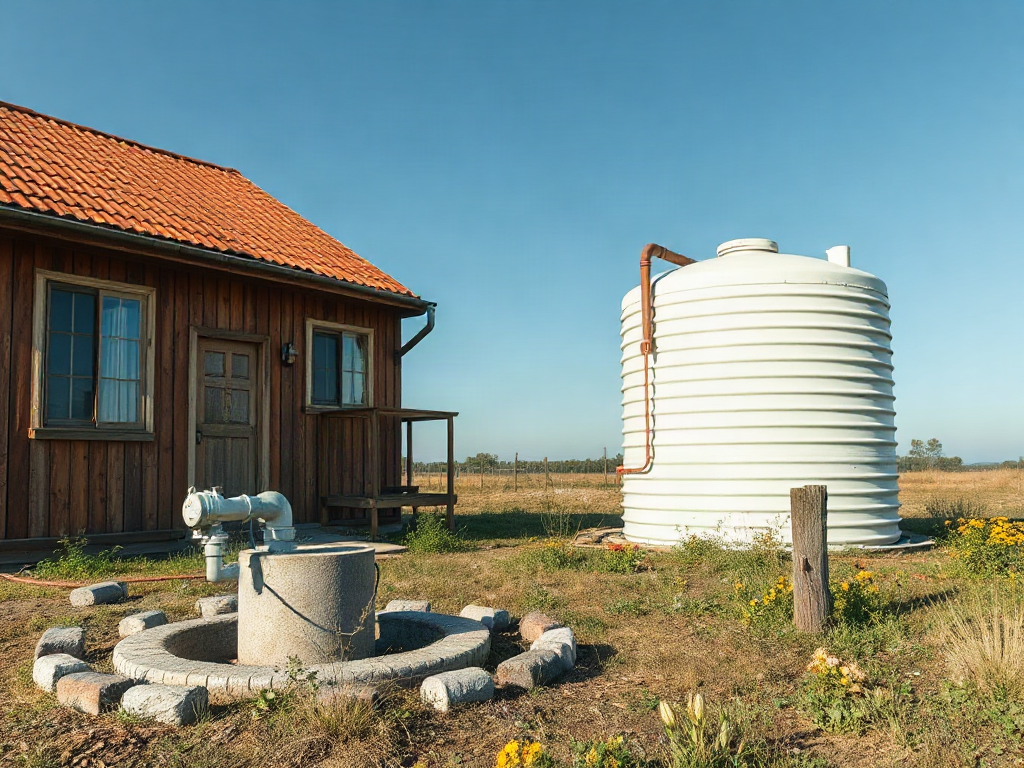
Water source planning before building a homestead farm means proving that a dependable supply can meet household, livestock, irrigation, and fire-protection needs before locating buildings or buying major equipment. Estimate peak daily demand, verify seasonal well or spring performance, test water quality, and map the elevation and distance between the source, storage, and every point of use. Include treatment, pumping power, freeze protection, and reserve storage in the design. A productive-looking property can become costly to operate when water yield is assumed from a brief inspection or when barns and gardens are placed beyond practical distribution lines.
What you’ll learn
This guide covers the following practical points:
- Calculate Total and Peak Water Demand — A useful demand estimate separates household consumption from farm uses that fluctuate by season.
- Verify the Source Through Dry and Wet Seasons — Source presence does not establish source reliability.
- Test Water Quality for Each Intended Use — Water quality must match its use rather than merely look or taste acceptable.
- Design Storage, Pumping, and Distribution — The layout should use elevation, short pipe runs, and accessible equipment to reduce operating difficulty.
Calculate Total and Peak Water Demand
A useful demand estimate separates household consumption from farm uses that fluctuate by season. Drinking, bathing, laundry, livestock watering, crop irrigation, produce washing, equipment cleaning, and emergency reserves place different pressures on a water system. Combining them into one rough daily figure can conceal the short periods when demand is highest.
Build the estimate around the homestead as it is likely to operate during its busiest realistic season. A summer garden may need water when a household has guests, laying hens are drinking more, and stored rainwater is nearly depleted. Future additions also matter: a planned orchard, dairy area, greenhouse, or second dwelling can exceed a system sized only for the first year.
| Demand Category | What to Record | Peak-Use Question |
|---|---|---|
| Household | Residents, fixtures, laundry, food preparation | Will several uses occur at once? |
| Livestock | Species, herd size, seasonal conditions | What happens during hot weather? |
| Crops | Irrigated area, crop type, delivery method | How much must be applied during a dry spell? |
| Farm operations | Cleaning, processing, workshops, greenhouses | Can these tasks be scheduled away from household peaks? |
| Reserve | Outages, repairs, firefighting access where applicable | How long must the property function without pumping? |
Penn State Extension advises estimating water needs before drilling a well or developing a spring. That sequence prevents buildings, fences, and production goals from being committed to a supply that has not been evaluated. A common mistake is sizing everything around average consumption; pumps, pressure systems, and storage must cope with peak demand as well.
Verify the Source Through Dry and Wet Seasons
Source presence does not establish source reliability. A flowing spring in a wet month, standing water in an old well, or a nearby creek may look promising without demonstrating usable yield during drought, freezing weather, or extended pumping.
For a well, obtain available drilling logs, depth records, construction details, and pump-test information. A qualified well contractor can assess recovery rate and sustained yield under local conditions. Springs require similar scrutiny: measure flow repeatedly, inspect the catchment, and determine whether surface runoff can enter the collection structure. Ponds and streams involve evaporation, sediment, contamination exposure, access rights, and possible restrictions on withdrawal or alteration.
Rainwater is valuable for gardens and other suitable non-potable uses, but collection depends on roof area, precipitation timing, tank capacity, and a safe method of handling overflow. It should not be treated as a guaranteed year-round supply without comparing storage against the longest plausible dry interval.
A resilient property often uses a primary source plus a practical backup. The backup might be stored water, a second approved source, or a connection point for delivered water. The weak approach is counting several unverified sources as redundancy. Two shallow sources affected by the same drought may fail together.
Test Water Quality for Each Intended Use
Water quality must match its use rather than merely look or taste acceptable. Clear water can still contain microorganisms, minerals, salts, or other constituents that affect people, animals, plumbing, irrigation, and food-handling activities.
Arrange laboratory testing appropriate to the source and local conditions before finalizing treatment equipment. A local health department, environmental agency, or extension office may identify common regional concerns and explain applicable testing or permitting procedures. Well construction, septic placement, surface-water use, and potable-water requirements vary by jurisdiction, so site-specific confirmation is necessary.
Interpret results by use. Hardness and iron may create scaling or staining without representing the same concern as microbial contamination. Salinity can damage sensitive crops or soils even when the water has another acceptable use. Livestock suitability can differ by species and life stage, so questionable results warrant advice from an appropriate laboratory, veterinarian, extension specialist, or water professional.
Treatment also changes system design. Filters, softeners, disinfection units, or other equipment may require electricity, drainage, maintenance space, replacement media, and adequate flow. Buying a generic treatment package before receiving test results is a costly failure mode because the equipment may not address the actual water chemistry.
Design Storage, Pumping, and Distribution
The layout should use elevation, short pipe runs, and accessible equipment to reduce operating difficulty. Mapping the well or spring, proposed house, barns, garden, greenhouse, hydrants, tanks, septic components, and vehicle routes exposes conflicts before excavation begins.
Elevation affects both pumping effort and delivered pressure. A garden far uphill from a well may require different pumping or storage arrangements than a downhill watering point. Long runs and undersized pipe increase pressure loss, while exposed lines are vulnerable to freezing, impact, and animal damage. Local frost depth, terrain, soil, and maintenance access should influence routing.
Storage can bridge the difference between slow source recovery and short periods of heavy use. For example, a modest-yield well may refill a properly sized cistern gradually while irrigation draws from stored water at a higher rate. Storage does not create water, however; sustained demand still cannot exceed the source over time. Tanks also need suitable foundations, protected openings, overflow control, inspection access, and measures appropriate to potable or non-potable service.
Plan how the system behaves during a power failure or pump breakdown. Gravity-fed reserve storage may serve selected uses where terrain permits, while a generator-ready pump may be appropriate elsewhere. Agriculture Victoria describes the objective of farm water planning as having water when and where it is needed. That requires distribution and backup planning, not simply identifying a source.
Complete the Prebuilding Water Checklist
A prebuilding decision should rest on records, field verification, and written cost estimates. Complete the water investigation during the property-evaluation and site-design stages, while structures can still be moved or the purchase reconsidered.
- Inventory sources: Mark wells, springs, ponds, streams, roof catchments, easements, and neighboring infrastructure without assuming access rights.
- Estimate demand: Record present and planned household, animal, crop, processing, and reserve needs, including peak-season overlap.
- Verify performance: Collect logs and test records, commission appropriate yield assessments, and investigate seasonal behavior.
- Test quality: Use a qualified laboratory and select treatment only after interpreting results for each intended use.
- Map the system: Lay out tanks, pumps, pressure equipment, treatment, pipes, hydrants, drainage, power, and maintenance access.
- Price the complete installation: Include excavation, electrical service, controls, freeze protection, treatment, storage, permits, and eventual component replacement.
- Confirm local requirements: Check water withdrawal, well, septic, plumbing, pond, and building rules with the relevant authorities.
Warning signs include missing well records, a seller’s claim that a source “never runs dry,” one water sample collected long ago, unexplained low pressure, sediment after rain, or a layout that places the septic system near a proposed source. A favorable sign is documentation that connects tested yield and quality to a mapped, serviceable system with room for expected expansion.
Frequently Asked Questions
Should a well be drilled before the house site is finalized?
The source should be investigated early enough that verified yield, water quality, access, and required separation distances can influence the house site. Coordinate drilling with the full site plan rather than choosing either location in isolation.
Can rainwater be the only source for a homestead?
It may be feasible in some climates and jurisdictions, but roof area, rainfall distribution, storage capacity, treatment, legal requirements, and drought backup must all be evaluated. Annual rainfall alone does not prove year-round reliability.
How can a low-yield well support peak farm demand?
A storage tank can accumulate water between demand periods and supply short peaks at a higher rate. The source must still produce enough over time, and the tank, pump, controls, and treatment must be designed as one system.
Is clear well water safe to drink?
Appearance cannot establish safety. Use an appropriate laboratory test and follow local guidance on sampling, result interpretation, treatment, and retesting.
What is the most common water-planning mistake?
Assuming that finding water is equivalent to having adequate water. Sustainable yield, peak demand, seasonal reliability, quality, distribution cost, and backup capability all affect whether a source can support the intended homestead.
Conclusion
Resolve water feasibility before permanent placement of the house, barns, gardens, and septic components. Document peak demand, verify source recovery across realistic conditions, obtain suitable laboratory testing, and price the entire delivery system rather than the well alone. A scaled site map and written findings from qualified local contractors or agencies provide a sound basis for redesigning the layout, reducing the initial scope, or declining a property whose supply cannot support its intended use.
Additional Resources
Authoritative Sources
- Managing farm water supplies
agriculture.vic.gov.auJul 22, 2026 — The goal of farm water planning is to have the water you need, when you need it, where you need it. Essential elements of farm water planning ...
- Water System Planning: Estimating Water Needs
extension.psu.eduMay 29, 2025 — Planning should be done prior to having a well drilled or spring developed to ensure that an adequate supply of water is available. Estimating ... Read more