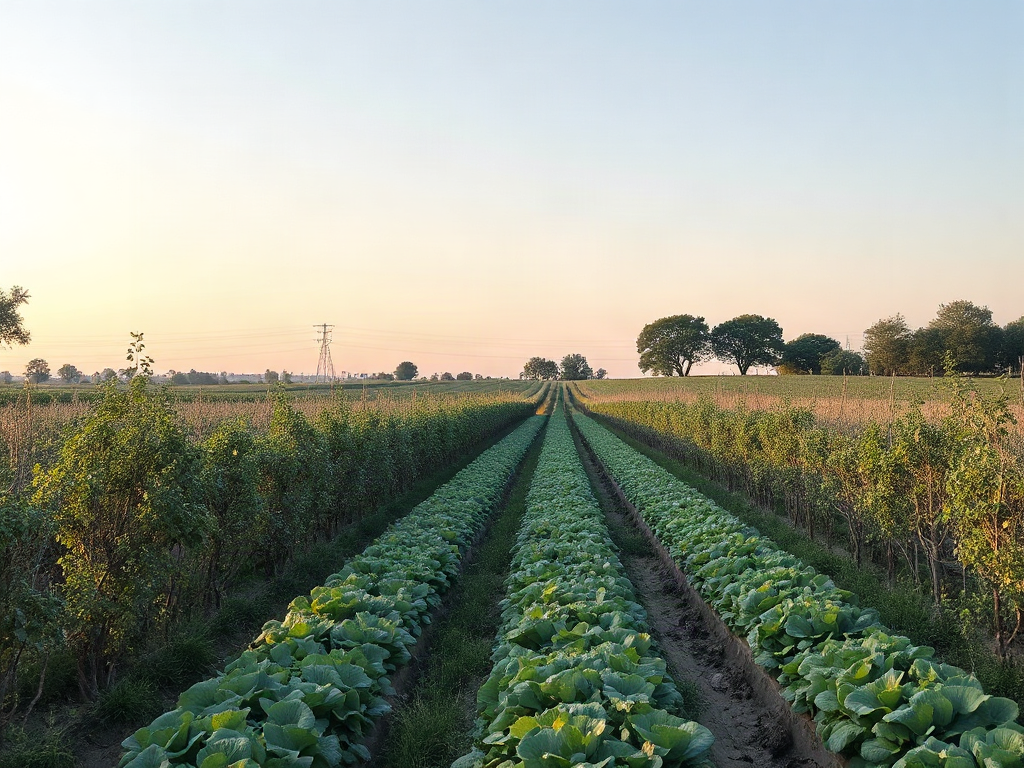
Homestead farm windbreak placement for crop protection works best when a porous barrier stands upwind of vulnerable beds, crosses the prevailing damaging wind, and leaves enough room to avoid crop shading and root competition. A moderately permeable row of shrubs and trees slows air rather than forcing turbulent gusts over a solid wall. Protection extends downwind, but its useful reach changes with windbreak height, density, terrain, and seasonal wind direction. Map summer and winter winds separately, preserve equipment access, and avoid low areas where cold air must drain. Temporary fencing or annual plants can protect crops while a living windbreak matures.
What you’ll learn
This guide covers the following practical points:
- Map the Winds That Actually Damage Crops — The wind direction that matters is the one associated with crop injury, exposed soil, lodging, blossom loss, or rapid moisture depletion—not necessarily the direction that occurs most often.
- Position the Windbreak for Useful Coverage — A windbreak should generally run across the damaging wind, with the crop area on its downwind side.
- Choose the Right Density, Height, and Planting Form — A useful crop windbreak filters air instead of acting like a solid wall.
- Test, Maintain, and Correct the Layout — Windbreak performance should be checked during the weather it was designed to moderate.
Map the Winds That Actually Damage Crops
The wind direction that matters is the one associated with crop injury, exposed soil, lodging, blossom loss, or rapid moisture depletion—not necessarily the direction that occurs most often. A homestead may receive routine breezes from one quarter but suffer its strongest spring gusts from another. Seasonal timing matters because bare seedbeds, young transplants, flowering crops, and mature corn do not respond to wind in the same way.
Begin with a simple site sketch showing property lines, crop blocks, buildings, roads, slopes, wet ground, overhead utilities, and existing woody vegetation. Add arrows for damaging winds during planting, summer growth, and autumn harvest. On sloping ground, mark the downhill path of cold air as well. A dense planting placed across that drainage route can trap cold air over low crops and increase frost exposure even while reducing wind.
Use observations from several weather events rather than relying only on a regional prevailing-wind map. Bent plants, soil deposited along fences, repeated snow drifting, and one-sided drying provide local clues. Ribbon streamers temporarily attached to stakes can reveal how barns, tree lines, and hedges redirect airflow. Observe from safe locations and remove the ribbons afterward so they do not become litter or entangle wildlife.
A common mistake is selecting the most convenient boundary and assuming it protects the garden. If damaging wind approaches diagonally across that boundary, it can enter around the end of the planting. Extend the planned windbreak beyond the crop block where space permits, or use a short return leg to reduce end effects.
Position the Windbreak for Useful Coverage
A windbreak should generally run across the damaging wind, with the crop area on its downwind side. It does not need to form a perfect right angle in every situation, but a nearly perpendicular alignment usually intercepts more airflow than a row running parallel to the wind. Curved boundaries and mixed wind directions may justify an L-shaped layout rather than a single straight row.
Distance from the crop involves a tradeoff. Placing woody plants immediately beside vegetable beds provides nearby shelter but increases shade, root competition, leaf fall, and turning difficulty for equipment. Moving the row farther away protects growing space from those conflicts, although very distant crops may receive less shelter. Judge distance in relation to the expected mature height of the windbreak, not the height of newly planted seedlings.
| Site Condition | Placement Priority | Risk to Check |
|---|---|---|
| Open, level vegetable plot | Cross the main damaging wind and extend past both plot ends | Future shade and roots near permanent beds |
| Garden below a slope | Keep a route open for downhill cold-air drainage | Frost pooling behind a dense lower barrier |
| Several small crop blocks | Protect the most exposed edge first | Gaps that funnel wind toward another block |
| Limited boundary space | Use a narrower shrub row or temporary porous screen | Choosing plants too large for the available width |
Consider an illustrative layout with a rectangular garden exposed to northwest spring winds. A row along the northwest side intercepts the threat directly; extending it past the garden corners reduces wraparound gusts. If the southern boundary has the easiest planting access, putting the row there would be simpler but would leave the spring wind largely unobstructed and could cast unwanted shade toward the crops.
Preserve access for mowing, pruning, harvesting, irrigation repair, and emergency entry. A design that blocks the only tractor lane or crowds a fence will be difficult to maintain. Mark the mature canopy width and working clearance on the plan before digging.
Choose the Right Density, Height, and Planting Form
A useful crop windbreak filters air instead of acting like a solid wall. Air passing through leaves, twigs, and stems loses speed gradually, while some air travels over the top. A solid fence can create sharp pressure differences and turbulent eddies on its downwind side. A living row with visible but distributed openings usually produces a broader, calmer transition.
Height influences how far downwind the shelter reaches, while density affects how smoothly wind speed changes. A short hedge may suit low vegetables near a compact garden. Taller mixed rows can cover a larger field but occupy more land, cast longer shadows, and require more years to establish. Avoid selecting tall trees merely to maximize reach when the protected plot lies on their sun-facing side or beneath utility lines.
Species selection should follow the site rather than appearance alone. Match plants to drainage, soil reaction, winter exposure, mature width, local pest pressure, and available irrigation during establishment. Where possible, combine plants with complementary heights and retain foliage near ground level; wind can accelerate through a bare lower gap beneath trees. Locally appropriate shrubs may be easier to fit around a small crop plot than full-sized evergreens.
Use this priority order when choosing the planting form:
- Protect the target season: Deciduous plants may filter summer winds well but offer less winter cover after leaf drop.
- Fit mature dimensions: Account for canopy spread and permanent access, not nursery size.
- Maintain permeability: Staggered plants can close gaps without creating a completely solid face.
- Plan the establishment period: Install a temporary porous screen, annual cover strip, or tall seasonal crop if immediate shelter is needed.
The frequent failure is planting one tight row for quick density and then neglecting thinning or replacement. Crowded plants may lose lower branches, develop weak form, or leave holes when one specimen dies. A slightly wider, maintainable arrangement often performs more reliably over time than an inaccessible wall of vegetation.
Test, Maintain, and Correct the Layout
Windbreak performance should be checked during the weather it was designed to moderate. Walk the crop area after windy periods and compare plant movement, soil drying, mulch displacement, and physical damage at several distances from the row. Uniformly calmer leaves and less soil movement suggest useful filtration; violent swirling immediately behind the barrier suggests excessive solidity or an awkward gap.
Temporary structures provide a low-risk way to test placement before committing to trees. Install a securely anchored, porous agricultural screen along the proposed line and observe airflow through a season. The screen must be suitable for the expected wind load and positioned where failure would not damage people, livestock, buildings, or power lines. If it creates drifting, turbulence, or access problems, revise the alignment before installing permanent plants.
Inspect a living windbreak at least seasonally for dead plants, open lower gaps, invasive spread, irrigation failures, broken limbs, and branches encroaching on crop space. Replace losses before a narrow opening becomes a wind funnel. Pruning should preserve the intended filtering structure rather than shearing the entire row into an impermeable face. Root pruning or barriers may be considered in constrained garden settings, but they add labor and can affect plant stability or health.
Watch for unintended crop responses as the planting grows. Increasing shade, slower morning drying, persistent frost pockets, or falling yields along the nearest beds indicate that the original spacing no longer fits mature conditions. Corrective options include shifting sun-loving crops, lowering or selectively thinning compatible plants, widening the service strip, or relocating beds. The mistake is treating the first layout as permanent even when the windbreak changes height and density every year.
Frequently Asked Questions
Which side of a crop field should a windbreak be placed on?
Place it on the upwind side of the crops relative to the winds that cause the most damage. Confirm seasonal direction locally because damaging spring or storm winds may differ from the usual breeze.
How close should trees be to a vegetable garden?
There is no universal spacing because mature height, canopy width, roots, sun angle, and equipment access differ by species and site. Plot the plants at mature size and leave a service strip before choosing the final line.
Is a solid fence a good crop windbreak?
A solid fence may create strong turbulence immediately downwind. A secure barrier with distributed openings generally filters airflow more gradually, although construction and wind-load requirements still need careful attention.
Can a windbreak make frost damage worse?
Yes. A dense row across a slope can obstruct downhill cold-air drainage and allow colder air to pool around crops. Keep natural drainage routes open, especially above low garden areas.
What can protect crops while trees and shrubs are growing?
A properly anchored porous screen, a strip of tall annual plants, or another temporary permeable barrier can provide interim shelter. Test its airflow and ensure it cannot collapse onto crops, roads, livestock areas, or utilities.
Conclusion
Effective placement begins with evidence from the site: the direction and season of damaging winds, the route of cold-air drainage, and the mature footprint of the proposed plants. Draw those constraints before selecting species or digging holes. Favor a permeable barrier that extends beyond the crop edge, retains maintenance access, and does not impose excessive shade or root competition. Test uncertain layouts with a temporary porous screen, then monitor turbulence, crop drying, frost pockets, and changing shade as the permanent planting develops.