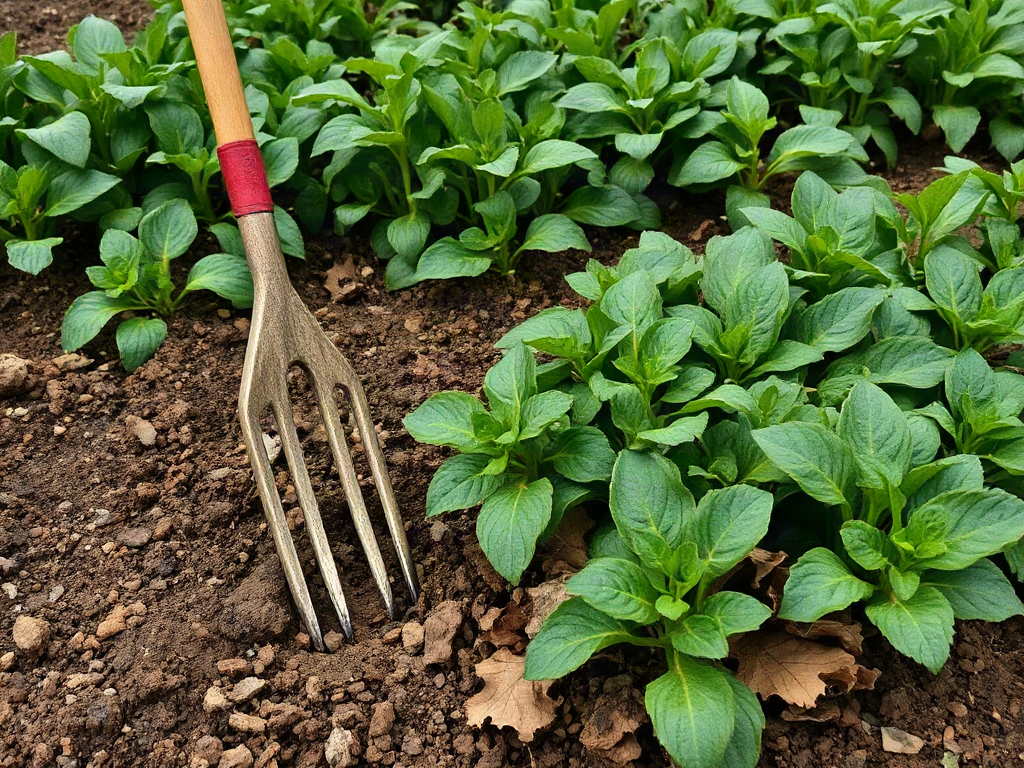
Improving compacted soil without heavy farm equipment means restoring pore space gradually with roots, organic matter, surface protection, controlled traffic, and carefully timed hand-tool aeration. First identify whether the restriction is a shallow crust, a dense worked layer, or deeper subsoil compaction by checking moist soil with a spade or probe. Keep people, carts, and livestock off wet ground, because pressure on moist soil can recreate the problem quickly. Broadforking may loosen a garden bed without inverting its layers, while taproot cover crops and compost provide slower, longer-lasting structural improvement. Success appears as easier infiltration, deeper rooting, more earthworm channels, and soil that crumbles rather than smears.
What you’ll learn
This guide covers the following practical points:
- Confirm the Depth and Severity of Compaction — Compaction should be located before the soil is disturbed.
- Loosen Soil With Hand Tools Without Inverting It — Mechanical loosening works best when the tool reaches just beneath the dense layer and the soil is at the right moisture level.
- Use Living Roots to Open Dense Soil — Living roots provide slower but more persistent improvement than one-time cultivation.
- Rebuild Structure With Organic Matter and Mulch — Finished compost and plant residues improve the conditions that allow soil particles to form stable aggregates.
Confirm the Depth and Severity of Compaction
Compaction should be located before the soil is disturbed. A sealed surface after hard rain needs a different response from a dense layer six inches below a repeatedly tilled garden. Digging or tilling indiscriminately can temporarily fluff the surface while leaving the restrictive layer intact.
Test when the ground is moist but not saturated. Push a straight metal rod, soil probe, or long screwdriver into several locations and note where resistance increases. Then cut a narrow soil profile with a spade. Compacted soil often shows flattened roots, roots turning sideways, few visible pores, blocky clods, or a smooth smeared face. Compare suspected ground with soil beneath a fence line or another area that receives little traffic.
Check drainage before assuming density is the only problem. A naturally heavy clay may resist a probe yet still have stable channels and healthy roots. Conversely, standing water can result from a low spot, a high seasonal water table, or runoff arriving from uphill. Loosening soil will not correct those site conditions by itself.
A simple infiltration comparison adds useful evidence. Place equal bottomless cans a few inches into the ground in the affected and unaffected areas, add the same depth of water, and observe how each drains. This is a field comparison rather than a laboratory measurement, but a large difference helps identify where surface sealing or poor pore continuity is limiting water entry.
Loosen Soil With Hand Tools Without Inverting It
Mechanical loosening works best when the tool reaches just beneath the dense layer and the soil is at the right moisture level. Ground that is too wet smears and compresses; very dry clay may fracture into hard blocks and require excessive force. A handful should hold together when squeezed but break apart when pressed with a finger.
For established garden beds, insert a broadfork or garden fork vertically, lean the handle back enough to lift and crack the soil, then withdraw the tines. Move backward in short increments so loosened ground is not immediately stepped on. The goal is to create fractures and preserve soil layers, not to turn the bed upside down.
A broadfork is efficient across permanent beds, while a standard fork is more practical around perennial roots or in a small plot. A digging bar can open isolated planting holes in very hard ground, but punching widely spaced holes alone does little for the soil between them. Rotary tillers can make the surface look workable while repeatedly creating a dense layer at their operating depth.
Deep loosening is not automatically better. Stop if the tool is cutting major tree roots, bringing pale or poorly drained subsoil to the surface, or requiring unsafe force. Work narrow strips over more than one season if the area is large. After loosening, add roots or surface cover promptly; bare fractured soil can settle back together under rain.
Use Living Roots to Open Dense Soil
Living roots provide slower but more persistent improvement than one-time cultivation. Roots enter existing cracks, release compounds that support soil organisms, and leave channels after they decay. Those channels can carry air and water deeper, provided traffic does not collapse them again.
Choose plants for the season and intended use. Cereal rye or annual ryegrass develops a dense fibrous root system that stabilizes the upper soil. Daikon-type forage radish sends a thicker root into available fractures and can leave larger openings after winterkill or decomposition. Oats offer fibrous growth and may be easier to terminate where cold winters kill the stand. Deep-rooted clovers can maintain living cover longer, although they may require deliberate termination before vegetable planting.
Cover crops do not drill effortlessly through every hardpan. Thick roots may fork or turn sideways when density is extreme, while fibrous species may remain above a compacted layer. In that situation, shallow broadforking followed by immediate seeding is often more effective than expecting plants to repair the profile alone.
Keep seed in firm contact with the surface and maintain enough moisture for establishment. Mow, cut, or crimp the cover before it produces unwanted seed, using a termination method suited to the species and next crop. Pulling the plants removes roots and disturbs the channels being created, so cut tops at the soil line when practical.
Rebuild Structure With Organic Matter and Mulch
Finished compost and plant residues improve the conditions that allow soil particles to form stable aggregates. Compost is not a pry bar for a hard layer, but it supplies decomposed material that soil organisms can incorporate around newly opened pores. Surface mulch also softens the impact of rain, reducing crust formation and rapid drying.
Spread a modest surface layer of mature compost rather than burying large quantities in deep trenches. In vegetable beds, apply it across the bed and mix only into the upper few inches if planting requires incorporation. Cover it with leaves, clean straw, chopped plant material, or another weed-free mulch. Keep thick mulch away from seed rows until seedlings emerge because cool, shaded soil can delay germination.
Avoid treating sand as a quick amendment for clay. Small, poorly mixed additions may produce a dense, concrete-like matrix rather than useful structure. Large-scale texture alteration requires substantial material and uniform mixing, making biological aggregation and protected pores more realistic for most homesteads.
As an illustrative sequence, consider a 4-by-12-foot bed with resistance beginning about five inches down. Loosen it once with a broadfork, spread finished compost over the surface, sow oats and forage radish, and keep all foot traffic in adjacent paths. Cut the cover before the next crop and leave the roots in place. The hand-tool treatment creates initial cracks; roots, residues, and traffic control make those openings more likely to persist.
Prevent the Soil From Compacting Again
Traffic management usually determines whether soil improvement lasts. The USDA Agricultural Research Service identifies tractors, harvesting equipment, and implement wheels traveling over moist ground as common causes of agricultural compaction. On a small property, repeated footsteps, loaded wheelbarrows, mower wheels, and concentrated livestock movement create the same type of pressure on a smaller footprint.
Establish permanent beds narrow enough to reach from the sides and place boards, wood chips, or gravel on permanent paths. Use the same route for carts and avoid entering beds after irrigation or rain. If soil sticks to boots, forms shiny impressions, or squeezes into a ribbon underfoot, postpone traffic and cultivation.
Livestock require separate judgment. Hooves can deeply compact saturated gateways, feeding stations, and narrow lanes. Rotate access, move feeders before mud develops, and use a durable sacrifice area where temporary exclusion is not possible. Adding mulch to a muddy route without correcting concentrated traffic may simply push organic material into the compacted layer.
Recheck the soil rather than scheduling aggressive loosening every year. Useful signs include water soaking in with less ponding, roots extending below the former barrier, more crumbly aggregates, and reduced force needed to insert a fork. Persistent sideways roots, recurring puddles, or a dense layer at the same depth indicate that traffic, drainage, or cultivation practices still need correction.
Frequently Asked Questions
Can compacted soil recover without digging?
Yes, if compaction is moderate. Continuous plant cover, deep-rooted cover crops, compost, mulch, and restricted traffic can improve pore continuity gradually. Severe hard layers may need one careful loosening treatment first.
Is a broadfork suitable for clay soil?
A broadfork can fracture moist, workable clay without fully turning it. Do not use it when clay is saturated and smearing or so dry that the tool requires unsafe force.
How long does biological soil loosening take?
Visible improvement may develop over one or more growing seasons. Timing varies with compaction depth, root growth, moisture, organic inputs, soil texture, and whether traffic has been controlled.
Will adding compost alone fix hard soil?
Compost supports aggregation and soil organisms, but it may not penetrate an existing dense layer. Pair it with living roots, surface protection, and limited hand-tool loosening where resistance is severe.
Should compacted ground be tilled repeatedly?
No. Repeated tillage can break aggregates, leave soil bare, and form another dense layer at the tool's working depth. Use targeted loosening only when field checks show it is needed.
Conclusion
Begin by locating the restrictive layer and ruling out drainage problems. Loosen only workable soil, then protect the new fractures with cover-crop roots, mature compost, mulch, and permanent traffic lanes. Watch infiltration and root direction rather than judging success by a fluffy surface. If puddling or sideways roots persist, reassess water movement and traffic before repeating cultivation; durable recovery comes from keeping pore space open after the initial repair.
Additional Resources
Authoritative Sources
- Soil Compaction - Agricultural Systems Research
ars.usda.govJan 10, 2025 — The most common causes of soil compaction or hardpans are tractors, harvesting equipment and implement wheels traveling over moist soils. Read more